Domestic abuse
Just DesertsDomestic abuse is presented as a pattern of psychological injury, coercive control, and unchecked household power rather than solely as physical violence. In Elizabeth Bennet’s experience at Longbourn, daily verbal attacks from Mrs. Bennet are intensified by Thomas Bennet’s failure to intervene, while the attempt to push Elizabeth toward William Collins turns marriage into an instrument of family convenience. The novel gives this abuse a lasting consequence: Elizabeth leaves Longbourn for the Gardiners’ household, carrying both the wound of familial betrayal and the determination to build a life governed by love, dignity, and choice.
Definition and Household Structure
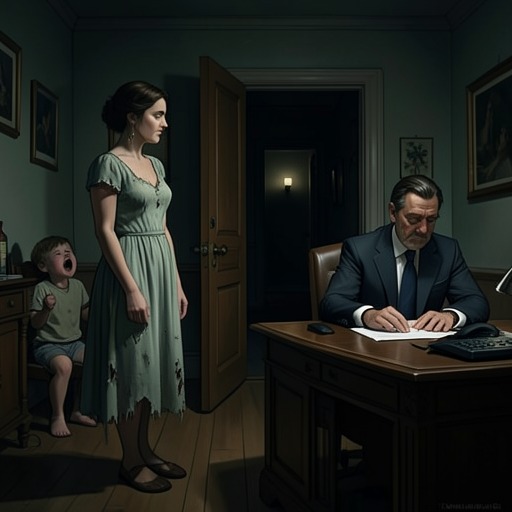
Domestic abuse at Longbourn operates through repetition and authority. Elizabeth describes being verbally chastised by Mrs. Bennet every day, often many times a day, while Thomas Bennet does nothing to restrain his wife or repair the damage. His authority is therefore exercised selectively: he can refuse Elizabeth permission to visit the Gardiners and can require her to remain at Longbourn for an additional fifteen days, yet he does not use that authority to protect her from the household’s daily hostility. The injury is not an isolated quarrel but a domestic system in which the person capable of stopping the abuse chooses retreat instead.
Elizabeth’s understanding of this system is sharpened by Sir David Pentland, who explains that beatings need not be physical. The comparison gives psychological cruelty a bodily reality: the bruises Mrs. Bennet has inflicted are on Elizabeth’s psyche rather than her skin, but they are bruises nonetheless. The image challenges the household’s implied distinction between respectable family discipline and genuine violence. What Longbourn normalizes as maternal anger has accumulated into a recognizable injury, and what Thomas Bennet treats as an inconvenience has become a threat to his daughter’s ability to live securely in her own home.
Coercion Through Marriage and Religion
The family’s pressure becomes most explicit when Mrs. Bennet tries to push Elizabeth into William Collins’s marriage proposal. Elizabeth later tells Edward Gardiner and Madeline Gardiner that her mother wanted to “sell” her to William Collins because doing so would serve Mrs. Bennet’s interests. The proposed marriage would have given Elizabeth a material advantage, since she would eventually have become Mistress of Longbourn, but Elizabeth insists that it offered no intellectual, mental, emotional, or spiritual benefit. The transaction therefore exposes the logic of her abuse: her welfare is measured in property and family security, while her inner life is treated as expendable.
Elizabeth’s refusal produces immediate retaliation. She tells the Gardiners that what they witnessed at Christmas was a sharper and more virulent version of what she had endured throughout her life. Mrs. Bennet then calls her selfish every day for more than eight weeks, including on Christmas Day. Elizabeth accepts the label only ironically, turning the accusation back upon the person who has used affection, guilt, and social expectation to compel obedience. By invoking Saint Paul’s letter to the Galatians and the principle that “for whatever a man sows, that he will also reap,” she frames the household’s conduct as having consequences rather than as an unfortunate family temperament.
The coercion also defines Elizabeth’s view of marriage. She declares that, should marriage ever happen for her, it will not be a loveless or soulless transaction. That decision is a direct response to the abuse surrounding William Collins’s proposal: she refuses to exchange psychological safety for economic security. Her resistance is socially defiant because it rejects the marriage-market logic that treats a daughter as a solution to a family’s property problem. Marriage can become partnership only when consent and emotional reality are treated as more important than convenience.
The Decision to Leave Longbourn
Elizabeth’s departure follows a period of deliberate reflection rather than a sudden burst of anger. Four days after her twenty-first birthday, she considers whether to ask Thomas Bennet for permission to visit the Gardiners in London. Although legally of age, she remains subject to her father’s authority while living at Longbourn, and his earlier refusal has shown her that his decisions may be capricious exercises of power rather than judgments made for her benefit. She recognizes that asking permission may simply give him another opportunity to control her movement.
As the fog lifts and sunlight appears, Elizabeth resolves to walk out of Longbourn the next morning if the weather remains dry. She writes loving and explanatory notes to Jane Bennet and Mary Bennet, apologizing for not revealing her plan, and writes a separate note to Thomas Bennet only after five attempts to keep her bitterness from showing. The letter is short and factual. Though she signs it “love Elizabeth,” its emotional emptiness reveals how far the father-daughter bond has deteriorated.
Her final day combines affection with escape. Elizabeth spends the afternoon with Jane Bennet and Mary Bennet, visiting a tenant family in order to leave the house and enjoy quiet company away from Mrs. Bennet and Lydia Bennet. She nevertheless joins the family for a last dinner, and the calm she feels confirms that the decision is not an impulsive act she will regret. The following morning she leaves through the kitchen at her usual brisk pace, neither running nor strolling, and looks back only once. When the hedgerow hides Longbourn from view, the house disappears physically as well as emotionally.
Consequences for the Family
Thomas Bennet understands the consequence only after Elizabeth has gone. Alone in his study, he looks at the chair where Elizabeth had often sat and asks how he allowed the situation to develop. He knows the answer: he has hidden among his books while Mrs. Bennet went unchecked through the rest of the house. His private sanctuary has existed at Elizabeth’s expense, while she has had no sanctuary of her own. The irony is complete when he realizes that she now possesses one twenty-four miles away, at the Gardiners’ home on Gracechurch Street, and that she will not return.
Mrs. Bennet reacts with a mixture of outrage and satisfaction when told that Elizabeth has gone to London to stay with the Gardiners for the foreseeable future. Her anger eventually subsides after several days, but the relief does not constitute recognition or remorse. Instead, her attention shifts back to Jane Bennet, Mary Bennet, Catherine Bennet, and Lydia Bennet, with marriage remaining the central subject of her conversation. The household’s pattern therefore continues even after Elizabeth’s escape: the abuse has not been understood, only redirected.
Elizabeth’s move gives her a practical alternative to dependence on Longbourn. The Gardiners provide a household in which she can recover distance from the daily attacks and speak openly about what has happened. Her later explanation to them makes clear that leaving is not a rejection of family affection in general. She continues to value Jane Bennet and Mary Bennet, while distinguishing their companionship from the destructive atmosphere created by Mrs. Bennet and enabled by Thomas Bennet.
Wider Contrast and Significance
The novel places Elizabeth’s domestic experience beside Radha Bhimani Pentland’s history of overt and structural violence. Radha Bhimani Pentland was born in Kutch, lost her mother in childbirth, and grew up amid repeated displacement caused by conflict among the Mughals, the Marathas, and the British. She was kidnapped when she was only a year older than Elizabeth Bennet is at the time of her own crisis and was intended to be sold into slavery. After rescue off the coast of the Arabian Peninsula, she was forced into a Spanish nunnery outside Cadiz for six years and later sent without meaningful consent on a mission to Cartagena. Her ship was captured by pirates, and after surviving severe injury she was left behind as the rest of the order continued onward.
Radha’s suffering is physically extreme, but the novel uses her testimony to illuminate a related principle: violence is also sustained by the social responses that blame survivors for having been exposed to danger. After Sir David Pentland rescued and nursed her in Barbados, Radha was subjected to barbed comments and even heard that it would have been better if she had died. Her supposed “original sin” was living too near the coast in India, yet society treated her survival as an embarrassment. Sir David Pentland finally resigned his naval commission because of this treatment, married Radha after she disclosed what had happened, and returned with her to Britain.
Elizabeth draws on Radha’s example when explaining to the Gardiners what she has learned about being a gentle-born lady. She also places Radha beside Madeline Gardiner, observing that the two women could hardly be more different in origin and social position, yet both taught her that love is expressed through practical daily conduct. This comparison prevents domestic abuse from being treated as a private annoyance without moral or social context. Whether the violence is enacted through captivity, survivor-shaming, verbal humiliation, or coercive family arrangements, the decisive question is whether the vulnerable woman is treated as a person with authority over her own life.
Domestic abuse thus becomes one of the novel’s central tests of family responsibility. Elizabeth’s departure exposes Thomas Bennet’s passive complicity, Mrs. Bennet’s willingness to sacrifice her daughter’s happiness, and the danger of confusing a house with a home. Her escape does not erase the past, but it converts recognition into action: she leaves, seeks refuge with the Gardiners, and refuses to accept any future marriage that reproduces the logic of purchase and submission.